
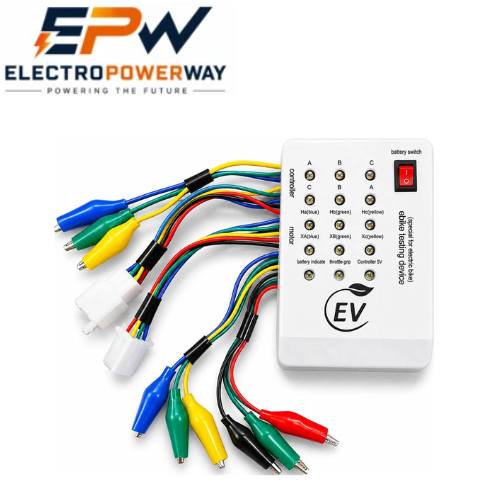
E-Bike Testing Device
The E-Bike Testing Device is a practical diagnostic tool designed to help technicians and electric vehicle repair professionals troubleshoot common electrical problems in electric bicycles and compatible electric scooters. E-Bike Testing Device It is particularly useful for checking BLDC motors, motor controllers, Hall sensors, throttle signals, brake signals and motor phase-related connections. Instead of testing every component separately with multiple tools, an e-bike testing device can provide a convenient way to identify common electrical and signal-related issues during repair and maintenance.
Electric bikes commonly use a Brushless DC (BLDC) motor together with an electronic motor controller. E-Bike Testing Device These systems depend on correct communication between the motor, Hall sensors, controller, throttle and other electrical connections. When an e-bike does not start, runs irregularly, produces abnormal motor behavior or fails to respond correctly to the throttle, identifying the faulty component can sometimes be difficult. The E-Bike Testing Device is designed to make this diagnostic process more convenient for technicians.
The tester can be useful for checking BLDC motor Hall sensor signals and identifying potential problems with Hall sensor connections. E-Bike Testing Device Hall sensors provide position information to the controller, and an incorrect or missing signal can affect motor operation. By checking the relevant connections and indicators, technicians can get a better understanding of whether the motor’s Hall sensor circuit is responding as expected.
The device can also be useful when troubleshooting e-bike motor controllers. Controllers are responsible for managing power delivery between the battery and BLDC motor. Faulty wiring, incorrect connections or controller-related issues can cause the motor to operate incorrectly. This testing device can assist technicians during controller diagnosis by providing a convenient method for checking compatible motor and control connections.
Another useful application is throttle signal testing. Electric bicycles commonly use a throttle or accelerator input to communicate the rider’s requested motor operation to the controller. If an e-bike does not respond properly to throttle input, the throttle, wiring or controller input may require inspection. The tester can help technicians check compatible throttle-related signals during the troubleshooting process.
The device can also assist with brake signal diagnosis on compatible electric bike systems. Many e-bikes use electronic brake-cutoff signals that temporarily stop motor assistance when the brake is activated. A problem in this circuit can sometimes prevent the motor from operating normally. Testing the relevant brake signal and wiring can help technicians locate potential electrical issues.
Motor phase and winding-related testing is another important part of BLDC motor troubleshooting. Brushless motors use multiple phase connections between the motor and controller. Incorrect, damaged or faulty connections can cause starting problems, unusual motor behavior or poor operation. A suitable e-bike testing device can help technicians inspect compatible phase-related connections as part of a broader diagnostic procedure.
E-Bike Testing Device
The tester is designed with indicator lights and clearly arranged connections on compatible models, helping users observe electrical status during testing. Visual indicators can make the troubleshooting process easier, particularly for technicians who regularly service different electric bikes and BLDC motor systems.
The compact design makes the E-Bike Testing Device convenient for workshops, mobile repair technicians and EV service centers. It can be kept with other diagnostic equipment and used when checking electric bicycles, electric scooters and other compatible BLDC-based vehicles. Its practical design is especially useful for technicians who need a dedicated tool for electric vehicle electrical troubleshooting.
This testing device can be useful for e-bike repair shops, electric scooter service centers, EV technicians, battery repair professionals, BLDC motor technicians and DIY maintenance users with suitable technical knowledge. It can help reduce the time required for basic fault diagnosis by providing a dedicated testing solution for commonly inspected e-bike electrical components.
Before using the tester, users should verify the voltage range, connector configuration, wiring arrangement and supported system type of their particular model. E-bike electrical systems can vary considerably between manufacturers and models. Connecting a tester to an incompatible system may produce incorrect results or potentially damage equipment. Always follow the product’s applicable wiring and operating instructions.
The E-Bike Testing Device is therefore a useful addition to an EV technician’s diagnostic toolkit. It provides a convenient approach to checking compatible BLDC motors, controllers, Hall sensors, throttle circuits, brake signals and related electrical connections. Whether used in an electric bicycle workshop, EV service center or maintenance environment, the device can make basic electrical troubleshooting more organized and efficient.
For technicians working with electric mobility products, having a dedicated diagnostic tool can simplify the process of locating common electrical and signal-related faults. The E-Bike Testing Device is designed as a practical solution for compatible e-bike and BLDC systems, helping users perform systematic testing before replacing expensive components such as motors or controllers.
Note: Exact voltage range, connector type, supported functions and testing capabilities may vary according to the specific tester model. Verify the actual product specifications before installation or use.

Reviews
There are no reviews yet.